Skip to content




Optimal recycling
As the need increases to be more sustainable, the used truck and recycled parts operation at Keltruck’s West Bromwich dealership off the M5 is proving its worth. Justin Burns reports
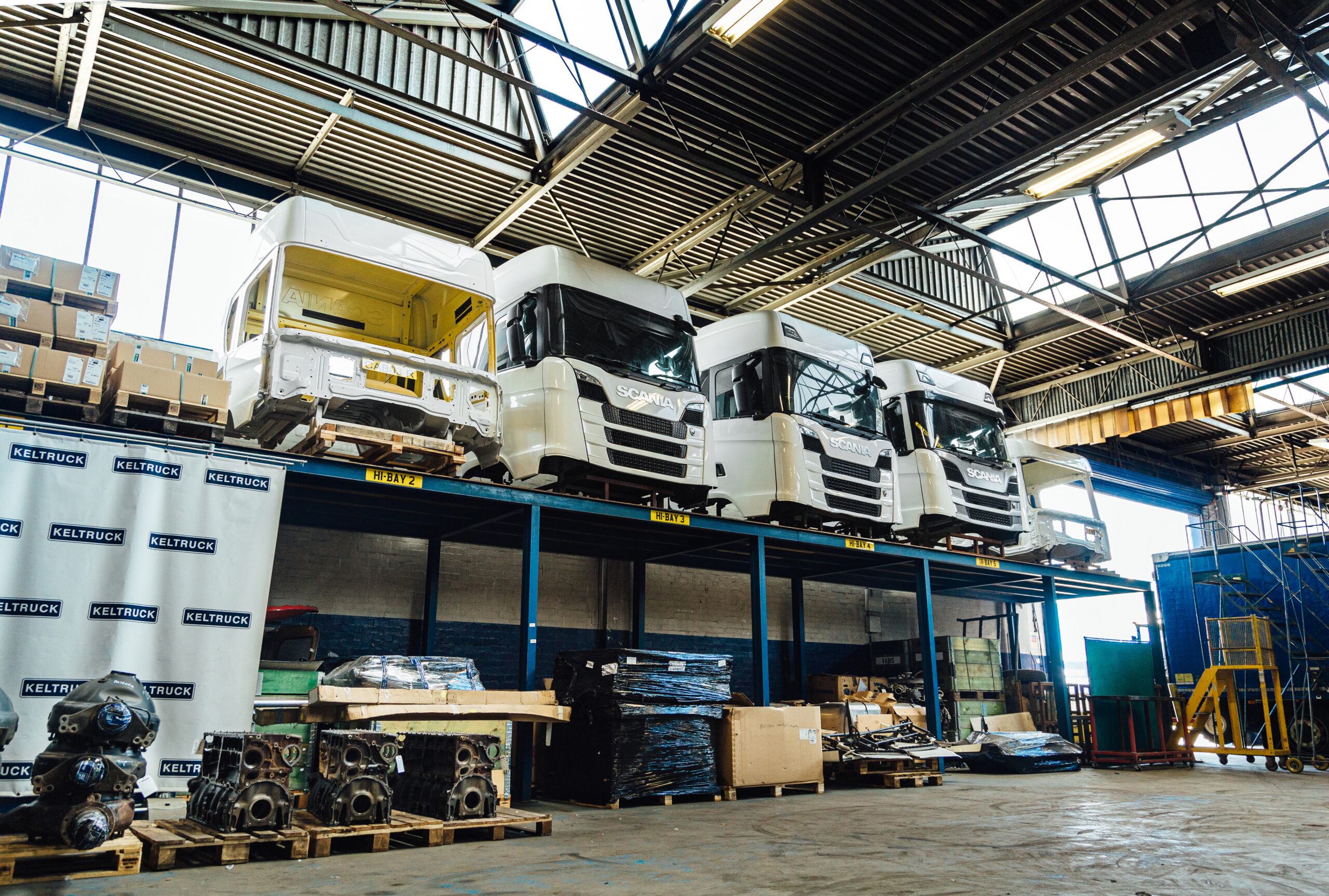
Keltruck’s West Bromwich dealership End-of-Life Vehicle (ELV) recycling parts division is no scrapyard of the past and maximises the life of every single component and part.
More than 70 skilled heavy goods vehicle (HGV) specialists ply their trade across the ELV site, the commercial vehicle workshop and commercial vehicle bodyshop, which all work seamlessly with each other.
Branch manager Andrew Pryjmachuk oversees the activities of all three and explains that the ELV division was established nearly 40 years ago and is the biggest of its kind in the UK.
“We operate under an ELV permit from the Environment Agency (EA) and have limits on how many vehicles we can store and keep,” he says. “We have procedures to accept waste, and it is all part of a legal framework that we operate under.
“Everything that comes off a vehicle is accounted for as part of the de-pollution process and conforms to our end-of-life certification with the EA.”
Pryjmachuk explains that interest in Keltruck West Bromwich’s ELV operation has come from far and wide, with interest from across Europe and even China, as others look to replicate the operation in other parts of the world.
The ELV division employs skilled HGV-trained technicians rather than just labourers, who have a detailed knowledge of the components and parts on every truck that comes through the doors.
The warehouse stocks more than 6,000 recycled parts with around 2,650 active parts, comprising a wide assortment of componentry. Keltruck can also help to locate parts not in stock.
OPERATIONAL TRUCKS
Every month, two to four trucks arrive through the doors of the ELV division, before they are dismantled and every component and part is then assessed.
Each is given a unique reference number and stored in the recycled parts stock warehouse to be either reconditioned or recycled. They are then used on refurbished trucks or sold to operators in need of a cost-effective replacement part.
Key to the success is the selection of the second-hand trucks that arrive in the ELV workshop, and the focus is now on buying used operational vehicles rather than damaged, salvaged ones. Most of the trucks are sourced from the Keltruck dealership network, but trucks are also sourced externally on demand or model type.
“We get the majority of vehicles from our own used sales department, which means we know the history as we have maintained them throughout their life,” Pryjmachuk says.
“They are complete trucks, so we can road test them, run diagnostics to assess the components and appraise the parts for re-use.
“We might also actively go out and find a vehicle for a specific customer parts requirement, such as a particular engine or cab variant, and then put the rest of it into stock.”
Paul Turner, parts manager for used parts operations, explains that the focus years ago was on buying accident damage write-offs, but due to the bidding war that has exploded online for damaged, salvaged trucks, there has been a shift to operational vehicles.
“You don’t know what you are buying when you buy a write-off because you don’t know to what extent the accidents caused any major damage to components,” he says. “The majority of the trucks we break today are from our used sales, so they are working trucks.”
The recycling operation has also caught the attention of insurance companies who are being put under pressure to be more environmentally friendly.
Pryjmachuk says representatives of an insurance company that recently had a tour of the facility indicated interest in using more recycled parts as part of their accident repair approval to meet their green agenda.
“If you look at it, a body panel that is brand new against a body panel that is two to three years old – there is not that much difference, especially when they are going to be painted anyway,” he says.
The ELV division has dismantled most Scania truck variants with the exception of battery-electric vehicles which are still in their early days. Pryjmachuk notes once the transition gathers pace it will prove “challenging” but predicted it would be at least five years before battery-electric trucks are processed through its recycling operation, so it will have plenty of time to overcome these challenges.
EXPORT MARKET
Recycled parts, assemblies and complete second-hand vehicles can also be prepared to meet export/import requirements and regulations. Keltruck can also arrange to convert vehicles to left-hand drive in its workshop prior to export and carry out any modifications or reconditioning to individual customer specifications.
With demand for right-hand drive vehicles not just limited to the UK, Jordan Foster, vehicle recycling national & international sales, says that Keltruck is experienced in responding to international demand for used parts and/or trucks.
He explains it has worked with export customers across the globe including as far afield as Thailand and Australia, while a recent project saw it refurbish a used truck that was then exported to Bolivia.
The ELV site at Keltruck West Bromwich also features a paint shop, meaning cabs can be tailored to meet a customer’s particular requirements.
Every part and component that is taken off each truck is either reused or recycled, and a recognised ‘hierarchy of waste’ process is followed.
Hazardous waste is also dealt with by working with Slicker Recycling, which has a joint centre base oil refinery. Instead of being burnt as fuel in the marine or energy markets, the used oil collected is sent back to its facility.
This oil is then reprocessed into a base oil product and used in the production of new carbon-efficient lubricating oils, emitting 30% less CO2 than alternative products produced from crude oil.
Working with local metal recycling facilities, any scrap metal is split into different categories and sold to be reused in the production of raw materials. These include heavy (chassis and heavy gauge metal), cast (axle, gearbox and casings), aluminium (component housing, radiators), light (general body panels) and precious (stainless, catalytic converters).
Keltruck West Bromwich’s End-of-Life Vehicle (ELV) recycling parts division warehouse stocks more than 6,000 recycled parts with around 2,650 active parts, comprising of a wide assortment of componentry and can also help locate parts not in stock
Source: transportengineer.org.uk/content/features/optimal-recycling